The 2011 presidential elections in Nigeria and Liberia

As of October 2010, it is foreseen that next year in one out of every three African countries presidential elections will be held, in 18 countries to be precise. In 9 more African countries parliamentary and/or local elections will be held too. This is a near-unprecendeted high number. Given the uneven distribution of Africa’s population over the continent it is hard to tell how many people are involved in this democratic upsurge. My estimate would be that in total this may affect the lives of about 500 million people, slightly over half the total population of the continent. Three countries alone – Nigeria, Egypt and the Democratic Republic of Congo – account for over 300 million, a striking illustration of the uneven distribution of the population over the continent.

Presidential elections are going to be held – apart from unexpected postponements – in one North African country: Egypt, in 6 West African countries: Benin, Cape Verde, The Gambia, Liberia, Niger, Nigeria, in 5 Central African countries: Cameroun, Central African Republic, Chad, the Democratic Republic of Congo (DRC), Sao Tomé & Príncipe, in three East African countries: Djibouti, Seychelles, Uganda, and in Madagascar, Zambia and Zimbabwe in Southern Africa. Before readers of this blog will accuse me of diffusing misleading information, I will immediately add that the number of ‘truly democratic countries’ can be counted on the fingers of one hand. Many countries have seen the tenure of office of the sitting president repeatedly prolonged, and the rulers of four countries even are among the longest serving African presidents: Hosni Muburak in Egypte (29 years), Paul Biya in Cameroun (28 years), Yoweri Museveni in Uganda (24 years) and Robert Mugabe in Zimbabwe (officially since 1987, de facto head of state since the country’s independence in 1980). To call these countries democratic countries would be besides the truth. The same applies to a number of other countries mentioned above though I will not dwell on this issue.

I will focus on two countries where in 2011 presidential elections will be held: Liberia, where Africa’s first democratically elected female president, Ellen Johnson Sirleaf, aspires a second term, whereas in Nigeria the successor of president Yar’Adua, a ‘northerner’, who died in office earlier this year, Goodluck Jonathan, a ‘southerner’ hopes to be become elected as the leader of Africa’s most populous country. The reasons why I selected these two countries out of the 18 where presidential elections will be held in 2010 are, first of all, that this blog is dedicated to events in Liberia, and secondly, because Nigeria – second in rank as Africa’s most important economy – is going to be an economic superpower, comparable to the BRIC countries (Brazil, Russia, India, China) that impress us nowadays.

Last week when I was in Abuja, the capital of Nigeria – inspired by the capital of Brazil since 1960, Brasilia……

To be continued

Posted in Elections in Africa, Elections in Liberia, Liberia, Nigeria | Comments Off on The 2011 presidential elections in Nigeria and Liberia

Democracy or Impunity? The Long Walk To Democracy In Africa (updated)

The following post is repeating my September 28 post which was incomplete due to technical difficulties. I have now included the links missing in my previous post.


Last week – in mid-September – it was announced in Monrovia that the infamous former Liberian warlord Prince Johnson is to run for President. Nineteen years ago Prince Yormie Johnson captured then President Samuel Doe, ordered his men to torture, mutilate and execute him, while all gruesome details were videotaped. The tape, showing Johnson watching the spectacle while drinking a Budweiser beer, later found its way all over West Africa, was shown on TV all over the world and can still be seen on YouTube.

On September 22, James Fromoyan, the head of the independent Liberian National Electoral Committee (NEC), said that Johnson’s recently created political party, the National Union for Democratic Progress (NUDP), met the constitutional requirements to compete in next year’s presidential elections. Insignificant as this news may have been, it immediately made it to the major news sites (AP, AFP, BBC, VOA, etc.). Good news travels fast, but bad news sometimes even travels faster.

All news sites mentioned Johnson’s responsibility for Doe’s death, some also referred to the final report of the Liberian Truth and Reconciliation Committee, which left no doubt as to the criminal record of Prince Johnson – now an elected senator for Nimba County. None of these news sites, however, mentioned Johnson’s claim that he murdered President Thomas Sankara of Burkina Faso in October 1987. Although all circumstances surrounding Sankara’s death are still (2010!) not yet known, there are very strong indications pointing to the involvement of warlord-turned-president Charles Taylor, Prince Johnson, and Blaise Compaoré, once Sankara’s best friend, and since October 1987 President of Burkina Faso.

Like Prince Johnson, Charles Taylor, and numerous other Liberian warlords, Blaise Compaoré has blood on his hands. Yet he has been President of this poor Sahel country for almost 23 years (1987 – present). Compaoré is far from the only African president enjoying impunity for his crimes. He is in the company of a large number of other African presidents, ranging from small-size countries such as The Gambia, Equatorial Guinea and Rwanda, to medium-sized countries such as Chad, Uganda and Zimbabwe, and big countries such as Ethiopa and Sudan – to name but the most obvious ones.

The Gambian President, officially: His Excellency President Sheikh Professor Alhaji Dr. Yahya Abdul-Azziz Jemus Junkung Diliu Jammeh, seized power in a bloodless military coup in 1994 but is being held responsible for a number of human rights abuses in the small West African country which is completely surrounded by Senegal. Equatorial Guinea’s Teodoro Obiang Nguema Mbasogo is in power since 1979 (!) after chasing his uncle, dictator Macias Nguema, who was executed shortly after the military coup. The fabulous oil revenues of this small country only benefit a small group of people close to the President.

Paul Kagamé led an invasion into Rwanda where he emerged as the military strongman after the 1994 genocide. He rules the country with an iron fist. In Chad, Idriss Deby was at first welcomed as a liberator after Chadian President Hissein Habré fled to Senegal in 1990 – with millions of stolen funds – but has since disappointed many. He manages to stay in power, using the country’s oil revenues, and has just celebrated his 20 years in power. Ugandan President Yoweri Museveni also came to power through the barrel of a gun – in 1985 – chasing his predecessor with a ‘liberation army’. He was one of the first ‘liberators’ in Africa to use child soldiers to fight his opponents and was / is internationally admired for bringing stability to the ‘Pearl of Africa’. Zimbabwe’s President Robert Mugabe (1980 – present) may not need any comments. Supported as a freedom fighter against the white minority regime of Ian Smith (1965 – 1980) he is a shame for Africa and the world. The atrocities in Matabeleland are – relatively speaking – small crimes compared to the devastation of the economy of what was once one of Africa’s most promising countries at independence.

In East Africa, the peoples living in two big countries, Ethiopia and Sudan, are not luckier with their governments. Meles Zenawi, headed a ‘liberation army’ like many of his colleagues, and in 1992 chased the Red Emperor of Ethiopia, Mengistu Haile Mariam, who has since lived in exile in Zimbabwe. Like Hissein Habré of Chad, Mengistu is internationally wanted, but has managed to escape from justice though he was sentenced to death by an Ethiopian court. Meles Zenawi, now officially Prime minister, after being President for many years, is the real ruler of Ethiopia. Does anybody know the name of the present President of Ethiopia?! Like all other African presidents mentioned here who came to power by military means – without distinction – Meles Zenawi was elected and re-elected, but increasingly used force, undemocratic means and human rights abuses to achieve his goals. Last but not least, President Omar al-Bashr of Sudan. He came to power trough a military coup in 1985 and is now wanted for war crimes and crimes against humanity.

The foregoing overview focuses on sitting presidents and leaves aside former presidents who since have disappeared following multi-party elections, another coup d’état or civil war, or because of a natural death (apart from Habré and Mengistu). The most notorious of them are Abacha (Nigeria), Doe (Liberia) and Mobutu (Zaïre/DRC).

Conclusion

I do realize that Sub-Sahara Africa counts nearly 50 independent countries – 48 to be precise, or 47 when we exclude Somalia (and ignore the existence of Somaliland and Puntland). I have excluded from the foregoing countries where more or less recently military coups took place: Central African Republic, Guinea Bissau, Guinea Conakry, Mauritania, Niger, not to speak of countries with ‘civil unrest’ or with an unresolved civil war like Ivory Coast – not to speak of Sierra Leone or Liberia…

What has the foregoing to do with Liberia or Prince Johnson?

The answer consists of two words: ‘Impunity’ and ‘Democracy’.

Do I need to say more?

Posted in Civil War(s) Liberia, Elections in Africa, Elections in Liberia, Impunity in Africa, Liberia, Samuel Kanyon Doe | Comments Off on Democracy or Impunity? The Long Walk To Democracy In Africa (updated)

Democracy or Impunity? The Long Walk To Democracy In Africa.

Last week it was announced in Monrovia that the infamous former Liberian warlord Prince Johnson is to run for President. Nineteen years ago Prince Yormie Johnson captured then President Samuel Doe, ordered his men to torture, mutilate and execute him, while all gruesome details were videotaped. The tape, showing Johnson watching the spectacle while drinking a Budweiser beer, later found its way all over West Africa, was shown on TV all over the world and can still be seen on YouTube.

On September 22, James Fromoyan, the head of the independent Liberian National Electoral Committee (NEC), said that Johnson’s recently created political party, the National Union for Democratic Progress (NUDP), met the constitutional requirements to compete in next year’s presidential elections. Insignificant as this news may have been, it immediately made it to the major news sites (AP, AFP, BBC, VOA, etc, but not only foreign, also Liberian). Good news travels fast, but bad news sometimes even travels faster.

All news sites mentioned Johnson’s responsibility for Doe’s death, some also referred to the final report of the Liberian Truth and Reconciliation Committee, which left no doubt as to the criminal record of Prince Johnson – now an elected senator for Nimba County. None of these news sites, however, mentioned Johnson’s claim that he murdered President Thomas Sankara of Burkina Faso in October 1987. Although all circumstances surrounding Sankara’s death are still (2010!) not yet known, there are very strong indications pointing to the involvement of warlord-turned-president Charles Taylor, Prince Johnson, and Blaise Compaoré, once Sankara’s best friend, and since October 1987 President of Burkina Faso.

Like Prince Johnson, Charles Taylor, and numerous other Liberian warlords, Blaise Compaoré has blood on his hands. Yet he has been President of this poor Sahel country for almost 23 years (1987 – present). Compaoré is far from the only African president enjoying impunity for his crimes. He is in the company of a large number of other African presidents, ranging from small-size countries such as The Gambia, Equatorial Guinea and Rwanda, to medium-sized countries such as Chad, Uganda and Zimbabwe, and big countries such as Ethiopa and Sudan – to name but the most obvious ones.

The Gambian President, officially: His Excellency President Sheikh Professor Alhaji Dr. Yahya Abdul-Azziz Jemus Junkung Diliu Jammeh, seized power in a bloodless military coup in 1994 but is being held responsible for a number of human rights abuses in the small West African country which is completely surrounded by Senegal. Equatorial Guinea’s Teodoro Obiang Nguema Mbasogo is in power since 1979 (!) after chasing his uncle, dictator Macias Nguema, who was executed shortly after the military coup. The fabulous oil revenues of this small country only benefit a small group of people close to the President.

Paul Kagamé led an invasion into Rwanda where he emerged as the military strongman after the 1994 genocide. He rules the country with an iron fist. In Chad, Idriss Deby was at first welcomed as a liberator after Chadian President Hissein Habré fled to Senegal in 1990 – with millions of stolen funds – but has since disappointed many. He manages to stay in power, using the country’s oil revenues, and has just celebrated his 20 years in power. Ugandan President Yoweri Museveni also came to power through the barrel of a gun – in 1985 – chasing his predecessor with a ‘liberation army’. He was one of the first ‘liberators’ in Africa to use child soldiers to fight his opponents and was / is internationally admired for bringing stability to the ‘Pearl of Africa’. Zimbabwe’s President Robert Mugabe (1980 – present) may not need any comments. Supported as a freedom fighter against the white minority regime of Ian Smith (1965 – 1980) he is a shame for Africa and the world. The atrocities in Matabeleland are even small crimes compared to the devastation of the economy of what was once one of Africa’s most promising countries at independence.

In East Africa, the peoples living in two big countries, Ethiopia and Sudan, are not luckier with their governments. Meles Zenawi, headed a ‘liberation army’ like many of his colleagues, and in 1992 chased the Red Emperor of Ethiopia, Miriam Mengistu, who has since lived in exile in Zimbabwe. Like Hissein Habré of Chad, Mengistu is internationally wanted, but has managed to escape from justice. Meles Zenawi, now officially Prime minister, after being President for many years, is the real ruler of Ethiopia. Does anybody know the name of the present President of Ethiopia?! Like all other African presidents mentioned here who came to power by military means – without distinction – Meles Zenawi was elected and re-elected, but increasingly used force, undemocratic means and human rights abuses to achieve his goals. Last but not least, President Omar al-Bashr of Sudan. He came to power trough a military coup in 1985 and is now wanted for war crimes and crimes against humanity.

The foregoing overview focuses on sitting presidents and leaves aside former presidents who since have disappeared following multi-party elections, another coup d’état or civil war, or because of a natural death (apart from Habré and Mengistu). The most notorious of them are Abacha (Nigeria), Doe (Liberia) and Mobutu (Zaïre/DRC).

Conclusion

I do realize that Sub-Sahara Africa counts nearly 50 independent countries – 48 to be precise, or 47 when we exclude Somalia (and ignore the existence of Somaliland and Puntland). I have excluded from the foregoing countries where more or less recently military coups took place: Central African Republic, Guinea Bissau, Guinea Conakry, Mauritania, Niger, not to speak of countries with ‘civil unrest’ or with an unresolved civil war like Ivory Coast – not to speak of Sierra Leone or Liberia…

What has the foregoing to do with Liberia or Prince Johnson?

The answer consists of two words: ‘Impunity’ and ‘Democracy’.

Do I need to say more?

Posted in Civil War(s) Liberia, Elections in Africa, Elections in Liberia, Impunity in Africa, Liberia, Samuel Kanyon Doe | Comments Off on Democracy or Impunity? The Long Walk To Democracy In Africa.

163rd Independence Anniversary Invites To Reflect And Celebrate

On July 26, Liberia and Liberians worldwide celebrate the 163rd anniversary of the independence of Africa’s oldest republic. On this occasion, two questions come to my mind. First, what explains that Liberia has managed to exist for over 160 years? Secondly, is it really an achievement??

It is quite a challenge to try to answer these questions in less than 400 words. Nevertheless, I will try it and tackle them.

How come that Liberia has survived despite all difficulties? ‘Cause difficulties, there were many. I will neither mention all nor elaborate on them: I would already exceed my maximum 400 words. The settler population that created the republic did not come voluntary to the shores of the Pepper or Grain Coast, definitely not all of them. Further, they had to start from scratch: there was nothing, all modern institutions a.s.o. had to be built. Moreover, the immigrants alienated the peoples living on the Pepper Coast by imposing their laws while at the same time excluding them from the benefits of these laws. Not surprisingly, after 133 years, the rule of the Americo-Liberians, as they preferred to call themselves, was violently overthrown. The chaos that followed led to an even more violent struggle for power which lasted some 14 years. Since then, Liberia re-started from scratch.

In my opinion, there are two major explanations for Liberia’s survival despite all these difficulties. First and foremost I must mention the US protection and support. Without the support of the American Colonization Society (ACS) in the 19th century and the US Government in the 20th century, for reasons of the Cold War, the Lone Star Republic would not have survived. It is not a coincidence that the worst part of Liberia’s contemporary history started after the end of the Cold War.

Secondly, the successive Liberian governments and foreign investors connived in the exploitation of the rich natural resources of the country. Under this arrangement – called the Open Door Policy – the governing elite used a portion of the proceeds of the economic development which took place – albeit in enclave sectors – to stay in power and live a comfortable life. The foreign investors were allowed to take the largest share of the cake. The foregoing is important since it contains important lessons for the future.

Then the second question. How much of an achievement is it to have existed for over 160 years?
According to most sources the world nowadays counts 195 independent countries leaving important aspects of constitutional law here aside. Only about a quarter of these 195 countries exists for more than a century.

In Africa there are three ‘old’ countries: The oldest one is Ethiopia, before the 20th c. called Abyssynia. The second oldest is Liberia. The third is the Republic of South Africa (officially the ‘Union of South Africa’) – besides, another country marked by immigration and ethnic conflict (!). The Republic of South Africa emerged in the early years of the 20th c. on the ashes of the defeated Boer Republics of which Transvaal (or South African Republic) and Orange Free State were the most important ones.

Throughout history many countries split, merged, changed their names or were swept from the world map as a result of war. E.g. the Austro-Hungarian Empire in Europe, the Ottoman Empire (aka the Turkish Empire) and, more recent, the Union of Socialist Soviet Republics (USSR).

‘Independent’ African countries that have disappeared are the Boer Republics in Southern Africa, created in the last quarter of the 19th century, and the Bantustans (aka Black African homelands) in particular Transkei, Bophuthatswana, Venda, and Ciskei (the so-called TBVC states) created by the Apartheid regime but which did not survive the fall of ‘Apartheid’.

Consequently, many countries no longer exist.

In light of the foregoing there is reason to celebrate in Liberia ‘July 26’. The answer to my second question is: ‘Yes, it is an achievement to have survived.’

But now, at the end of my reflections, a third question emerges: What else did Liberia achieve?

No doubt, a painful question. We will leave it until after the party.

I wish all Liberians a wonderful July 26!!

All Hail, Liberia, Hail! Click here for the music.

Posted in 'July 26', Liberia, Liberian History | Comments Off on 163rd Independence Anniversary Invites To Reflect And Celebrate

Is debt relief the solution?

When in 1926 Firestone gained control over Liberia’s public finance through a new – and according to some unnecessary – US $ 5 million loan which replaced all existing foreign loans of Liberia, there was a public outcry. Some people were outraged. Firestone wanted some control over the Liberian Government to protect its interests which consisted of what later proved to be a historic concession agreement for the production of natural rubber. The loan put the country virtually under the control of Americans and administrators appointed by people on the other side of the Atlantic Ocean. The Liberian Government was even forbidden to contract new loans without the written consent of Firestone!

Although there are many differences between this famous Firestone Loan and the debt relief Liberia recently obtained, there also are important similarities and, what is even more important, lessons to be learned. Because that’s ultimately the usefulness of history: to learn from it in order to improve present and future actions.

Let there be no misunderstanding about my joy for this historic debt write-off. President Ellen Johnson Sirleaf and her team are to be congratulated with this achievement. The US $ 4.6 billion (!) debt relief which Liberia thus obtained from multilateral, bilateral and commercial creditors erases a huge debt stock which contributed to discourage foreign and domestic investors to invest in the country and would have captured an important portion of public expenditures in order to service it – if the Liberian Government would have serviced its debt, which it did not do.

Since the 1980 coup d’état, followed by the 14-year civil war, none of the loans Liberia owed to foreign creditors were serviced, and thus penalties and arrears (interest payments and amortization of loans) grew every year. This had resulted in a staggering US $ 4.9 billion debt when Ellen Johnson Sirleaf was elected president. As President Sirleaf said in a nation-wide address informing the Liberian population of the debt cancellation: ‘Our budget for 2009-2010 is US $ 350 million. To settle that US 4.9 billion debt, we would have had to pay our creditors our entire budget for 28 years!’

It all began in 2008. In March of that year, after two years in office, President Sirleaf and (then) Finance Minister Antoinette Sayeh had succeeded in normalizing relations with the International Monetary Fund (IMF) and the World Bank. Being former World Bank officials, Ellen Johnson Sirleaf and Antoinette Sayeh are on good terms with the Bretton Woods Institutions and their staff. See my March 19, 2008 posting on this blog. I then announced that HIPC and PRSP would become household words in Liberia. HIPC stands for Heavily-Indebted Poor Country. Liberia joined this club of now 29 poor and heavily indebted countries in 2008, when it reached the so-called decision point (see the previous link, but scroll), the first step towards a more comprehensive debt relief. Shortly after Liberia became a so-called HIPC-country, Antoinette Sayeh was appointed Director of the IMF’s African Department, in May 2008, and returned to Washington DC where she had been living for 17 years, working with the World Bank, before joining Sirleaf’s administration in 2006. Also in 2008, the Sirleaf Administration submitted a Poverty Reduction Strategy Paper (PRSP) to the IMF and World Bank, one of the many conditions for further debt relief. Liberia worked hard to meet the other conditions for a comprehensive debt relief agreement and to reach the so-called completion point (see this link and scroll). These requirements are very technical, interested readers are referred to the HIPC site just mentioned.

Finance and Planning Ministers Augustine K. Ngafuan and Amara Konneh, who led Liberia’s HIPC delegation to Washington DC, returned to Liberia on June 29, announcing that Liberia had reached the HPIC completion point, thus obtaining the green light from World Bank and IMF for a US $ 4.6 billion debt cancellation. One of the conditions they noted was that now Liberia is only allowed to borrow for development projects. Another condition prescribed that loans should not exceed 2% of the country’s GDP which means US $ 40 million annually. Once more Liberia is placed under guardianship. This time not of the US overnment or a US company, but of the Bretton Woods Institutions.

President Ellen Johnson Sirleaf immediately expressed great satisfaction over the debt relief in a nation-wide address, comparing it with another Independence Day for Liberia. Antoinette Sayeh said that Liberia now has a real chance to develop with the debt burden lifted. Dr. Toga McIntosh Gaewea, former Liberian Finance minister and one of the brains behind the PRSP – now World Bank executive in Washington DC – praised the commitment of the Sirleaf administration to pro poor growth, macroeconomic stability, fiscal and monetary prudence and sustainable development through the PRSP and other development frameworks.

It is important to mention that one of the weakest points in the performance of the Sirleaf Administration refers to public finance management. Liberia did not fully meet the standards set by IMF and World Bank. In popular terms, the management of the public sector still suffers from mismanagment, inefficiency and corruption. However, this has not prevented the EU to immdiately grant budgetary support to the Government of Liberia to the tune of US $ 8.5 million. In light of the budgetary deficit Liberia is facing due to the worldwide economic crisis, a present from heaven.

Liberia’s economic history is one of relying on foreign capital, be it direct foreign investments or foreign loans. Notably the latter proved to do more harm than good. It started with the 1871 loan which led to the country’s first coup d’état and the death of President Edward Roye, followed by the loans of 1906 and 1912, the infamous 1926 Firestone Loan, and many more. Will the present step, erasing once more all of its debts, enable Liberia to definitely leave its ugly past of notorious borrower failing to meet its obligations?

I will not conceal that I have mixed feelings with respect to this as well as other debt relief deals, notably since it concerns countries which are well endowed with natural resources and where outright thievery and corruption combined with mismanagement are among the root causes of the inability to service the debt incurred. Moreover, the economic potential of these countries, rich in minerals, and a huge potential in agricutural development, should enable them to finance their own development. In the same week that Liberia reached the HIPC completion point another Sub-Saharan African country, also well endowed with natural resources, reached the HIPC completion point. On the eve of the 50th anniversary of its independence, the Democratic Republic of Congo (‘Congo-Kinshasa’) reached the HIPC completion point. This paved the way for the Paris Club to cancel more than US$ 13 billion.

These amounts always puzzle me. US $ 4.600.000.000,00 That is what it is. Four thousand six hundred million American dollars. I bet nobody reading this blog can explain me how much this really is. Take one million for you – and one for me 🙂 and we still have an amount left of US $ 4.598.000.000,00 – unbelievable.

Comparing the two countries,DRC and Liberia, I will immediately admit that I am far more optimistic about Liberia’s future and prospects than those of the DRC. There are many reasons for it, one of the most important being the commitment of the country’s leader.

Notwithstanding this difference, Liberia is far from leaving its ugly past behind. There still are many challenges. The country will need to regain the confidence of foreign investors – despite some recent successes in the agricultural and mining sectors. Liberia will have to stop borrowing for unproductive purposes. There are many, many more challenges.

Three priorities impose themselves. Failing to realize them will mean that the lessons of the infamous 1926 Firestone loan and the recent debt cancellation have not been learned. The proceeds of the infamous 1926 Firestone loan were not used for productive activities but were squandered. The HIPC debt relief of 2010 will also not benefit the people of Liberia unless the following three priorities will be rigorously pursued: 1) eradicate corruption, 2) improve infrastructure and 3) enhance agriculture.

Therefore, the answer to my question: ‘Is debt relief a solution?’ is an outright ‘NO’. Debt relief is no panacea for Liberia’s problems, as also Vice President Boakai and Finance Minister Ngaufuan said. But it represents an opportunity that should not be missed.

The penalty to miss it is misery and poverty. The Liberian people deserves better. It all depends on the leaders. Next year, presidental and legislative elections will be held. Who will be the new leader(s)? The country cannot afford missteps.
Posted in Liberia, Liberian Economy | Comments Off on Is debt relief the solution?

THINK Liberia – Touching Humanity In Need of Kindness, a new web site

Earlier this month a new web site and related blog was added to the many sites and blogs devoted to Liberia and Liberians. On June 7, http://www.thinkliberia.com/ was launched.

THINK Liberia or ‘Touching Humanity In Need of Kindness’ is a faith-based, Liberian, non-governmental organization established seven years ago, in 2003 – when the civil war was still raging – , a few months before the resignation of President Charles Taylor. A humanitarian NGO, ThinkLiberia focuses on the rights and well-being of women and children, notably ‘war wives’ of fighting forces, other victims of sexual violence, and child mothers.

Since 2003, ThinkLiberia has provided the following services:

* Safe homes where victims of sexual violence are given psychological support;
* Rehabilitation homes in Paynesville/Monrovia and Buchanan;
* A Learning Enrichment Program where children are tutored;
* A Participatory Action Research Program focusing the reinteration of girl mothers;

Recently, the Director of THINK in Liberia, Rosana Schaack, was one of the recipients for the Distinguished Leadership Award for Internationals by the University of Minnesota. Schaack was a student at the university (Humphry Institute of Public Affairs, Humphry Fellow 2008-2009).

The Distinguished Leadership Award for Internationals is a university-wide award for alumni, former students, and friends of the university who have distinguished themselves in their post-university work as leaders in their professional careers. The selection committee for the Award cited Rosana Schaack’s role as a public servant, her work to empower the poorest of the poor, and her mission to bring hope to those he need it most. The committee lauded her passionate voice for justice for the young woman and children of emerging Liberia and her total involvement in the fight against gender-based violence.

Both web site and blog are worth visiting, they merit to be added to your favorites. People like Rosana Schaack and her co-workers deserve our admiration and support, they are the builders of a new Liberia on the ruins of the old Liberia.

The plight of the victims of sexual violence should be a concern of us all. Whereas the victims need to be catered for, civil society, politicians and judges in particular should strive to bring to justice not only those responsible for these criminal and heinous acts, but also those responsible for creating an environment of lawlessness making these atrocities possible.

‘Let Justice Be Done To All’ (official Liberian motto ).

Posted in Liberia, Ordinary Liberians | Comments Off on THINK Liberia – Touching Humanity In Need of Kindness, a new web site

TPS and money transfer

The meeting between the President of perhaps the most powerful nation in the world and the President of maybe one of the weakest states on earth was historic.

On May 27, President Ellen Johnson Sirleaf was received by President Barrack Obama in the Oval Office of the White House. Other bloggers have already commented on this historic meeting. Therefore, I will focus on a particular aspect of their conversation.

President Obama did not hide his admiration for Africa’s first democratically elected woman-president when he publicly said that he had been an extraordinary admirer of her work for many years. President Sirleaf welcomed the US leader’s commendation on behalf of the Liberian people and noted that what President Obama observed about Liberia would not have been possible without the assistance of the United States. Notably, she thanked the US government for allowing some 14,000 Liberians currently living in the US on Temporary Protective Status or TPS and the Obama administration for a recent action taken to extend the delayed enforced departure for another year.

At the height of the First Liberian civil war (1989 – 1997), the government of the United States extended ‘temporary protection status’ to all Liberians who could get to the USA, and 14,000 of them took advantage of that humanitarian offer. Temporary protection status is an immigration status somewhere between political asylum and refugee status. Administered by the Department of Homeland Security and the U.S. Bureau of Citizenship and Immigration Services, it is extended to nationals of countries facing civil unrest or natural disaster.

How many Liberians are living outside Liberia?? Nobody knows, that’s for sure. Who dares to guess?

Official figures are by definition unreliable figures. My estimate is that at least 30,000 Liberians are living outside Liberia, half of them in the USA. The others are living in Europe or Africa. They represent at least one percent of the Liberian population, which may not be an impressive figure. However, though I have no firm figures at hand, I bet that their average educational level is above Liberia’s average. This means that the relative importance of the total number of Liberian abroad supersedes its actual number.

This phenomenon is not limited to Liberians. There are many Sudanese, Ethiopian and Eritrean people, varying from medical doctors to taxi drivers, working in the New England States and in the Washington DC area. The same is true for Europe. To just give one example: it is being estimated that about 1.5 million Nigerians are living outside Nigeria, legally or illegally. This number represents one percent of the most populated country in Sub-Saharan Africa: one out of every five black Africans is Nigerian. Interestingly, together they remitted home US $ 10 billion in 2009, according to the World Bank.

So, what could be the contribution of Liberians living outside Liberia to the survival of their relatives and friends, to the development of the Liberian economy, to the sustainability of the nation, to the future of their country?

If anybody knows the answer, please come forward. It could well be that Liberians abroad send, on an annual basis, remittances with an overall value of approximately US $ 30 million to Liberia, which represents about 10 percent of the National Budget. Not a huge amount, but for an unknown number of Liberians it may be the difference between life and death, it may pay for medicine or food which otherwise would not have been bought, or provide the small working capital for a market transaction or a small business.

Posted in Ellen Johnson Sirleaf, Liberia, Ordinary Liberians | Comments Off on TPS and money transfer

Gus Kouwenhoven on trial again – Dutch Supreme Court orders

Two years ago – on March 10, 2008 – I commented on the acquittal of Gus Kouwenhoven, also known as Guus van Kouwenhoven, a Dutch timber trader and business partner of Charles Taylor, accused of illegal arms trade for his business partner, and I lauded the Dutch judiciary system – see my March 10, 2008 blog posting. Today I repeat my praise. I just heard the news that the Supreme Court of the Netherlands has overturned the acquittal of Kouwenhoven and ordered a new appeal hearing. The Dutch Supreme Court said that appeals judges had been wrong to reject a prosecution request to hear two anonymous witnesses. Consequently, Mr. Gus, as he is known in Liberia, will have to stand trial again. Meanwhile he remains a free man.

‘Mister Gus’

The Dutch businessman Gus Kouwenhoven first came to Liberia in the late 1980s after shady deals in the USA where he had been convicted and sentenced to two years jail. In Liberia he became General Manager of the famous Hotel Africa, near Monrovia, later he went into the logging business and became Chairman of the Malaysian Oriental Timber Company, one of the largest timber companies in the country, and Managing Director of the Royal Timber Company. He also was a member of the Board of the Forestry Development Authority, a Liberian governmental institution mandated to regulate and supervise forest exploitation and timber production in the country.

In 2000, it was reported that Gus Kouwenhoven belonged to Taylor’s ‘inner circle’ and in the UN’s Expert Panel Report on Sierra Leone (2000) he was accused of active involvement in arms smuggling. He subsequently was hit by an UN travel ban though this did not prevent him from seeking refuge in Congo. In March 2005 he was arrested in Rotterdam, the Netherlands, where he had travelled to visit his family. In 2006, the District Court of The Hague sentenced Gus Kouwenhoven to 8 years in prison for illegal arms trade, but on March 10, 2008 the Dutch Court of Appeal overturned the 2006 conviction and acquitted Kouwenhoven of all accusations including allegations that he had participated in war crimes in Liberia.

The Special Court for Sierra Leone (SCSL)

In December 2009 one of Charles Taylor’s secret bank accounts was revealed by Prosecutor Nicholas Koumjian during the cross-examination of Charles Taylor at the SCSL in The Hague. Nicholas Koumjian ended the last hearing of the year with a sensational piece of evidence: a hitherto unseen statement from a personal bank account opened by Taylor in December 1999. Even more sensational was Taylor’s admission that it was a “covert account opened up by the Government of Liberia during this period, to fight our war”. According to the evidence two major deposits were made in 2000: US $ 2 million from Natura Holdings, owned by Gus Kouwenhoven, and US $ 3.5 million from the Taiwanese embassy in Monrovia. Taylor admitted that the money was used to buy arms.

Taylor’s statement seemingly contradicts previous statements by Kouwenhoven denying accusations that money from his company or companies was ever used to buy arms. The UN Expert Panel Report of 2000 had already linked him to arms purchases from the notorious arms dealer Victor Bout, an allegation that was also rejected by mister Kouwenhoven.

Oscar Wilde in his The Importance of Being Earnest already acknowledged that ‘The truth is rarely pure and never simple’.

I wish the Dutch judges all the wisdom they need to arrive at the right conclusion and a fair judgement that does justice to the interests of all victims of the Second Liberian Civil War (1999 – 2003).

Posted in Charles Taylor, Civil War(s) Liberia, Gus Kouwenhoven, Guus Kouwenhoven, Liberia, Liberian History | Comments Off on Gus Kouwenhoven on trial again – Dutch Supreme Court orders

April 12, 1980 – 2010

I can’t help but think of April 12, 1980 when the anniversary of Samuel Doe’s bloody coup d’état approaches. I happened to be in Monrovia on that historic day, en route to Burkina Faso, then still called Upper Volta, where I was to witness three more coup d’états of which Thomas Sankara’s seizure of power was the most impressive.

1980 – 2010. Liberia underwent more changes in the past thirty years than in the century before. Doe’s People’s Redemption Council marked a U-turn in the history of Africa oldest Republic where the roots of the recent turmoil had been developing since 1822. In that year the first freed slaves and free-born blacks set foot here on West African soil. Despised and unwanted in the land where their forefathers had been brought under coercion, they established a Republic based on the model of the land where they had been born and had grown up. And like the slave masters had treated them, they treated the aboriginal population they met on what used to be called the Pepper Coast.

1980 – 2010. In these thirty years Liberia had one military dictator-president who was the country’s first President of tribal origin, six Interim Presidents among whom Africa’s first female Head of State, one elected warlord-president who was forced to step down, one Vice President who after becoming President had the shortest Administration in the country’s history – three months. He was succeeded by a ‘caretaker’-not called President who in his turn was succeeded by Africa’s first elected female Head of State. Compare that with the previous 130 years which had known only 23 presidents, 12 of them born in the USA or the Caribbean, 11 born in Liberia, among whom the country’s longest serving President, 27 years.

1980 – 2010. The people of Liberia suffered from two civil wars which cost over 200,000 people their lives. Many more suffered, were wounded, and remained traumatized after the wars had ended. In the early years of the third millennium, Africa’s oldest republic had gained the reputation of a ‘failed ‘state’, a conclusion which I personally do not share, for various reasons.
But undoubtedly true is that when Ellen Johnson Sirleaf took over, in 2006, the modern economy was in ruins, the foreign investors had left, like most of the political and intellectual elite, and the people were poorer and more divided as ever. The latest census revealed that the total population now numbers more than three million, not much for a country well endowed with natural resources, but too large in view of the actual National Budget of about US $ 350 million. Compare that with total public expenditures thirty years earlier, which amounted to US $ 324 million, in 1979, and it may be difficult not to despair looking at this budgetary standstill.

However, I do not share this feeling of hopelessness, I also disagree with the qualification ‘failed state’. Yet I am puzzled how it can be possible that people inflict upon other people the cruelties which we have seen in Liberia. Though Liberia is not the only country in the world where people underwent these sufferings. What to think of the United States of America where a major civil war raged between 1861 and 1865, divided the country, and costs half a million people their lives? By the way, isn’t it an ironic coincidence that the US civil war started on April 12?

Who would have qualified the USA in 1865, when the civil war ended, as a ‘failed state’? And what about Europe? There may be no other continent where so many wars raged, yet most European countries rank among the richest in the world nowadays. And look at Asia, take the example of Vietnam. This country was virtually destroyed by the Americans in the 1970s. Nowadays it is one of the emerging Asian economies, with Indonesia, India and China.

Liberia, once Africa’s leading iron ore exporter and the third largest iron ore exporter in the world, with many other precious minerals, with the largest mercantile fleet in the world and the world’s largest rubber plantation within its borders, has the economic potential to recover from the wars and their aftermath. Liberia has many strong and intellectual people, the organization of the civil wars proofs it, as contradictory as this may sound. Both within and outside the national territory there are many hard working, capable and motivated people who in good combination with the nation’s natural wealth can turn the ‘Land of Liberty’, the previous ‘Pepper Coast’, into a small paradise where people harmoniously live together. The recipe? It is not as difficult as people tend to think. Good policies, in combination with investments in people, infrastructure and institutions have proven to be the road to take, leading to economic growth, development and prosperity.

Liberia can realize another U-turn, I am absolutely sure. The economic changes which the country underwent in the 1950 – 1980 period are proof of that – despite the ravages of the last 30 years. Government revenues rose from less than US $ 4 million (!) in 1950 to US $ 200 million in 1980. The National Product (GDP) was roughly some US $ 35 million in 1950, at the end of the 1970s it had grown to US $ 750 million. This was considered a phenomenal performance in those days despite the criticism and the conviction of many that Liberia could have done better had it managed better its economy and controlled more some foreign investors.

Liberia and Liberians should learn from the past if the next U-turn is to be realized. Yes, it can!

Posted in 'April 12', Charles Taylor, Civil War(s) Liberia, Ellen Johnson Sirleaf, Famous Liberians, Liberia, Liberian Economy, Liberian History, Samuel Kanyon Doe | Comments Off on April 12, 1980 – 2010

Ritualistic Murders, Voodoo and the Rule of Law

Eleven days ago, March 24, I wrote about ritual killings in Lofa County, Liberia, as well as in a number of other countries and the involvement of high ranking people, politicians and rich businessmen. Two days later a high profile ritual murder case was unearthed in Maryland County, involving several high-ranking government officials.

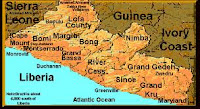
Former Interior Minister and Maryland Superintendent under previous Administrations, and at the moment of his arrest Ambassador-at-Large appointed by President Sirleaf, Dan Morias, former Associate Justice of the Supreme Court and former Maryland County Attorney Cllr Fulton Yancy, together with at least eight other persons, were arrested following a string of ritual murders. They are now in custody in the county capital’s jail, according to the Harper police ‘for protective reasons’. Some sources even report the arrest of as many as nineteen suspected ritual killers.

The circumstances surrounding their arrests caused President Ellen Johnson Sirleaf to warn against voodoo justice and raise many questions about the rule of law in Liberia.

Maryland County is notorious for its history of ritualistic killings, one of the most sensational being the ritual killing of Moses Tweh in 1977 for which ultimately seven persons were condemned and publicly executed, among whom a member of the House of Representatives, Allen Yancy, older brother of Fulton Yancy, and Maryland Superintendent James Anderson, son of the Chairman of the True Whig Party, in those days the only legalized political party. Not surprisingly, Marylanders’ past of ritual killings and fears resurfaces, as reported by Tom Kamara in The New Democrat Online. Besides, the famous Liberian journalist presents a chilling report on the interrogation techniques (read: torture) of the Liberian police in the Moses Tweh murder case.

The list of disappeared and ritually murdered people in Maryland County is long, but nobody knows how long. When the Minister of Justice, Christiana Tah, visited the County in the wake of the recent arrests she met with citizens who told her that between 1999 and 2010, 16 people had been reported missing and are believed to be victims of ritualistic killings. The minister acknowledged ‘that there are still lots of unresolved cases of this nature.’ Meanwhile Government has deployed additional and more police officers to Maryland to ensure security in the area.

Cllr Fulton Yancy is accused of killing the 7-month pregnant Tomo Allison and pulling the unborn child out, killing the baby too. The circumstances surrounding the discovery of evidence in his home are astonishing. The Liberia National Police used the services of a witch doctor or voodoo priest who reportedly went into Mr Yancy’s house and with the ‘aid of a young girl’ discovered two bottles of blood and human parts, and the intestines of the unborn child. The woman and child were reportedly killed four months ago. The use of traditional doctors or voodoo priests to solve crimes is not new. President Samuel Doe hired a Kissi voodoo high priest Contabu who was even officially employed by the Ministry of Internal Affairs. It has been reported that citizens of Bong County are now demanding that traditional priests are employed to solve ritualistic murders in their county.

The Harper Police handling of the ritualistic case is increasingly being criticized, both by the media and individuals like Dr. James Elliot, a Liberian pathologist based in the USA. Also President Sirleaf was very outspoken. She was closely involved in the arrests and investigation. She warned local people in Maryland against ‘sassywood’ or voodoo justice.

Cllr Fulton Yancy denies any involvement in the ritual murder of Tomo Allison, her unborn baby and others. So does the other top official arrested, Dan Morias. The latter accused unnamed Liberians of attempting to destroy his ambitions to become a Senator in the forthcoming elections of 2011.

Dan Morias is not an unknown in Liberian politics. The former Superintendent of Maryland County and Interior Minister was a close ally of warlord-president Charles Taylor and also on good terms with Taylor’s successor Guyde Bryant – who hails from Maryland County – and since he was nominated Special Envoy by President Sirleaf I assume that Morias also enjoys (enjoyed??) President Sirleaf’s confidence.

I remember that in 2008 Morias’ name was mentioned at a TRC hearing. Survivors recounted before the Truth and Reconciliation Committee the massacre of 369 civilians in 2003. In that year, militiamen loyal to Charles Taylor rounded up 369 inhabitants of Glaro and massacred them at various locations in River Gee County, which borders Maryland County. The killings, witnesses said, were executed by fighters of the ‘Mountain Lions Brigade’ under the supervision of former Maryland County Superintendent Morias and General William Sumo.

The definition of rule of law is a complicated issue and I will not attempt to provide one here. Nevertheless, a basic principle is that ‘Nobody is guilty unless found guilty after a fair trial.’ But who is meanwhile protecting ordinary people – men, women, children, babies even unborn -their basic human rights, in particular their right to freedom of fear?

Not only in Liberia this basic question remains increasingly unanswered, also in Uganda and South Africa, to name but two countries where new cases of ritual killings continue to emerge, criminals get away with their heinous crimes, and impunity is rather common than exception.

I am afraid the last statement of my March 24 posting is more valid than ever.

Posted in Liberia, Ritual Killings | Comments Off on Ritualistic Murders, Voodoo and the Rule of Law