Matilda Newport (1822) and the civil war

Today, December 1, I had to think of Matilda Newport, a Liberian heroine. Generations of Liberians of all walks of life and every possible background have grown up with ‘Matilda Newport’. For over a century, December 1 was celebrated as a national holiday throughout the country. Liberian school children paraded in the streets of Monrovia and other cities, honoring this courageous woman. Matilda Newport, as the story goes, was a settler-woman, who in 1822 helped to repel an attack on the first struggling settlement by local tribesmen, known as the battle of Crown Hill. Reportedly, she fired a cannon using a coal from her pipe and killed virtually all native people, chasing the survivors. She thus saved the colony.

Nowadays, the younger generation may hardly know who she was. Matilda Newport Day, as December 1 was known, was abolished some 30 years ago. It is typical for Liberia’s unfinished written history that sources differ as to who abolished this controversial holiday. According to some sources the leaders of the 1980 coup, Samuel Doe and his comrades, abolished the holiday which they hated because it symbolized the political and social divide of Africa’s first republic. Other sources state that the Matilda Newport holiday was discontinued by President William R. Tolbert, in his desire to demonstrate that he sought to further cement the unification of the country.

Who was Matilda Newport? Did she really exist or was she an invention of the Americo-Liberian ruling elite, to portray their superiority and to re-affirm the inferiority and cowardice of the aborigines who lived on the land they claimed?

Many Liberian historians and authors of history books have devoted many pages to Matilda Newport, such as Ernest J. Yancy, Richard A. Henries and A. Doris Banks Henries, C. Abayomi Cassell and Nathaniel R. Richardson. The accounts of the Matilda Newport story vary from author to author but have in common that most references to the ‘natives’ were negative: ‘savage, primitive, belligerent people’ (A. Doris Banks Henries).

Foreign scholars have also researched the Matilda Newport story, like Jane J. Martin and Rodney Carlisle, who conducted a study ‘The Search for Matilda Newport’, published in the Liberian Studies Journal in 1975. Also Svend Holsoe threw more light on Liberia’s heroine in a paper presented at the Liberian Studies Conference, Indiana University, in 2007, ‘Matilda Newport: The Power of a Liberian Invented Tradition’. Particularly I would like to recommend, however, the excellent writings of Siahyonkron Nyanseor. He conducted extensive research on Matilda Newport alleged deeds. His (unpublished) research paper is entitled: ‘Matilda Newport’s Deed, Myth or Reality’. In 2004 he published the essay ‘Putting to Rest the Matilda Newport Myth’ (see Part I and Part II). The following quotation is from this source:

“Based on available sources, Matilda Newport was a real person who resided in Liberia during this period. She came to Africa on the “Elizabeth,” March 9, 1820 at the age of 25 as Matilda Spencer, the spouse of the 32 years old, Thomas Spencer. According to records, she could not read nor write (illiterate). During the Battles of Fort Hill, Matilda Spencer was 27 years old. Had she performed the deed she is credited with, she would have been known as Matilda Spencer, and not Matilda Newport. Probably, her husband, Thomas Spencer was killed in one of the conflicts. According to the Emigrant List, he died as a casualty in 1822. Matilda Spencer married to Ralph Newport sometime after 1822. Her story borne of the need to pass on the so-called victory of the Settlers over the natives, and it was nurtured through myth of larger-than-life proportions (….)”.

Matilda Newport and the civil war

On September 3, 2008 a Liberian historian, Professor Augustine Konneh, testified before the Truth and Reconciliation Committee (TRC) that the system of authoritarianism, established by the American Colonization Society (ASC) and sustained and expanded by the various Liberian governments, from Joseph J. Roberts to Samuel K. Doe, laid the foundation of the civil war.

He said Liberians must also recognize and reconsider some of the nation’s myths, saying that myths exist in every society and Liberia is no exception. One of these myths, he said, is the Matilda Newport story, which he contended is an account of heroism on the part of Americo-Liberians and cowardice on the part of native Liberians. He said this false sense of heroism and cowardice have been the main source of conflict amongst generations of Liberians on either side of the political and social divide and thus undermine true patriotism and nationalism in Liberia.

I have a feeling (large) parts of Liberia’s history may have to be re-written.

Posted in Civil War(s) Liberia, Famous Liberians, Liberia, Liberian History | Comments Off on Matilda Newport (1822) and the civil war

Nine Blogs and Three Books – The True Liberian Spirit

The civil war left more than 200,000 peope dead and made many more victims: wounded or disabled people, child-soldiers, orphans, who had to restart their lives, often struggling with a trauma caused by unforgettable cruelties. When President Ellen Johnson Sirleaf took office, in January 2006, Liberia’s infrastructure was in shambles, the economy ruined, most (foreign) investors gone. Yet, despite all difficulties and impossibilities, the Liberian spirit is alive. Isn’t there a saying ‘Tough times don’t last, but tough people do!’ ?

Recently, three Liberian authors drew national and international attention with their books related to the Liberian crisis. Is it a coincidence that all three were women? They follow the footsteps of other Iron Ladies of Liberia, headed by President Ellen Johnson Sirleaf. First there is Elma Shaw with her novel ‘Redemption Road – The Quest for Peace and Justice in Liberia’. A very interesting book review and interview can be found here. Then there is Helene Cooper who wrote ‘The House at Sugar Beach – In Search of a Lost African Childhood’. Read the very informative September 10 book reviews on Shellby Grossman’s blog and Emmanuel’s blog if you want to know more about the book and Helene Cooper.

The third book will be published early 2009. It is Diana Taylor’s ‘Black Diamond’. It absolutely is an extraordinary book with a fascinating theme. The book announcement reads as follows:

“At sixteen, Ellen was a normal young Liberian girl. Her father called her ‘Black Diamond’, because she was so precious to him. But Liberia was being torn apart by civil war, a war that would destroy almost everything she loved. Government soldiers murdered Diamond’s parents in front of her. Diamond herself was then brutally raped, stabbed, and left for dead. Miraculously she survived. When she was strong enough she made an astonishing decision – to return to Liberia and fight on the side of the rebel forces. Rising quickly through the ranks Diamond became a leader of her own battalion of women. Many believed ‘Black Diamond’ must be a myth or a supernatural being – but in fact she was just a young girl, fearful but determined to create a better future for her country. This is her dramatic and heartbreaking true story of survival and courage – and of her struggles to create a new life both for herself and the women who fought with her. ”

Now, after the war, Ellen tries to rebuild her life. She is tired of fighing, the war, and reflects on the future: ‘We realized our goal. Charles Taylor is gone. I want to go back to school.’

The latest proof of the strong Liberian spirit – a survivor’s spirit – I found while reading David Sasaki’s blog. David writes about the free press in Liberia and how Liberian journalists become bloggers. His blog is part of an interesting site, Rising voices – Helping the global population join the global conversation. David describes how Liberians take advantage of modern media tools like blogs and photo-sharing sites. After a morning workshop at the US embassy in Monrovia, nine Liberian journalists have begun sharing their lives and stories with us on their newly created blogs. Here follows a list of their blogs:

http://firstnewsliberia.wordpress.com/
http://moussomag.wordpress.com/
http://bensliberia.wordpress.com/
http://jskpenneh.wordpress.com/
http://sengbeh.wordpress.com/
http://judicialreporternetwork.wordpress.com/
http://wwwtheforumnews.wordpress.com/
http://azangoliberia.wordpress.com/
http://gusdjaeploe.wordpress.com/

They cover different topics: sports, politics, diplomacy, the press, grassroots organizations, and – of course – the persistent scars of the civil war.

Does anybody know how long it takes for memories to become history?

We don’t know the answer to this question, but I want to thank and congratulate the three authors and the nine bloggers with their contribution to history and the rebuilding of the Liberian society!

Posted in Civil War(s) Liberia, Liberia, Liberian History | Comments Off on Nine Blogs and Three Books – The True Liberian Spirit

Rape of a Nation

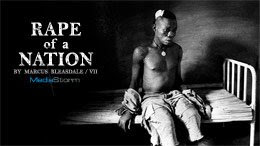
Today, by accident, I stumbled upon the magnificent website of Marcus Bleasdale, a former trader of interest-rate derivatives for the Bank of America, turned photojournalist. In 1998, after having won an award for being a rising young photojournalist, he worked in Sierra Leone and later in Central Africa. Reading Joseph Conrad’s Heart of Darkness he became intrigued with the Democratic Republic of Congo (DRC).

Conflicts among warlords, rebel groups and government forces over control of the country’s mineral wealth have left more than 5 million people dead since 1998 and created a humanitarian crisis in the country. Bleasdale made an impressive video called ‘Rape of a Nation’. I think you shouldn’t miss this movie because of the similarities with the Liberian civil war, except for the numbers.

Unlike the DRC, the Liberian war has ended. Both countries face the same problem: how to overcome the scars of the war.

Posted in Democratic Republic of Congo (DRC), Liberia | Comments Off on Rape of a Nation

“Did you know that….?” – My favorite facts and trivia on Liberia

I love facts. My favorite slogan is “Facts first, opinions later.” I also love factoids and trivia. Many are known ‘facts’, some may surprise. The entire list is a weird collection. Some ‘facts’ are fun-facts or useless knowledge, some ‘facts’ may increase our understanding of Liberia.

Here we go. Did you know that:

– The Liberian flag was modeled after the U.S. flag and the eleven red and white stripes of the Liberian flag stand for the eleven signers of the Liberian Declaration of Independence?

– The eleven delegates represented about 3,000 people (colonists) of whom only 600 had elected them?

– The Constitution of 1847 was written by an American Harvard professor, Simon Greenleaf?

– The original name of Monrovia was Christianopolis?

– Monrovia was named after James Monroe – 5th U.S. president – and Buchanan, Liberia’s second largest city, after Thomas Buchanan, the first Governor of the Commonwealth of Liberia and cousin of the 15th president of the U.S.A., James Buchanan?

– The original settlement of Liberia was purchased for trade goods, supplies, weapons, and rum worth approximately $300 but this was never paid in full?

– Liberia’s first president, Joseph Jenkins Roberts, was an octoroon, who could have easily passed for a white man?

– 12 Presidents of Liberia were born in the USA and only two Liberian Presidents were of full tribal descent?

– Liberia in 1960 was elected to the Security Council of the United Nations, the first black African country ever to occupy a seat in this body?

– In 1969 the Liberian Angie Brooks Randolph was chosen to preside over the 24th General Assembly of the United Nations?

– In the late 1970s Liberia was led by two religious leaders: President William Tolbert and Vice-President Bennie Warner?

– Liberia’s Ruth Perry was Africa’s first female head of state and President Ellen Johnson Sirleaf Africa’s first elected female President?

– One Liberian President won the presidential elections in what was classified by the Guinness Book of Records (1982) as the most fraudulent elections ever reported in world history?

– Samuel Doe’s PRC (People’s Redemption Council) was nicknamed ‘People Repeating Corruption’ and the Liberian Peace Council (LPC, one of the warring factions during the civil war) the Lost Property Collector because of their habit of looting homes?

– Liberia is about the size of Tennessee?

– Liberia has 1585 kilometers of borders – with Côte d’ Ivoire, Guinea, and Sierra Leone?

– Sapo National Park in Liberia is West Africa’s second-largest tropical rainforest and home to about 125 mammal species, including elephants, leopards, giant forest hogs, chimpanzees, duiker antilopes and the rare pygmy hippo?

– Liberia is an ornithological paradise, home to 700 species of birds, including the bee-warbler, a bird only slightly larger than a bee?

– Oprah Winfrey traced her ancestral roots back to the Kpelle in Liberia?

– The Liberian George Weah is the only African who in one single year – 1995 – was named FIFA World Player of the Year, European Footballer of the Year and African Footballer of the Year?

Certainly, more interesting facts and factoids exist. Please feel free to add your favorite ones!

Posted in Liberia, Liberian History | Comments Off on “Did you know that….?” – My favorite facts and trivia on Liberia

Some thoughts on the 2008/2009 Budget

On August 5, 2008 the Liberian Legislature agreed on a National Budget of US $ 298 million for the Fiscal Year 2008/2009. This was nearly ten percent higher than the US $ 277 million Draft Budget submitted by the Director of the Bureau of the Budget, Mr. Augustine Ngafua, a few months earlier. As President Ellen Johnson Sirleaf indicated when she commented on the Draft Budget to reporters, the draft budget represented an increase of almost 40 % over the last budget, which was US$199 million. It is interesting to note that the last performance report of the fiscal budget was not yet available when the proposed budget was submitted to the legislators.
More details on the 2007/2008 budget can be found here.

When I read this and after some additional reading, a few comments came to my mind.

(1) When President Sirleaf took office, in January 2006, the budget for FY 2005/2006 amounted to US $ 85 million (yes indeed, eighty-five million US dollars!). In a few years time the Sirleaf Administration managed to raise this to almost US $ 150 million, in FY 2006/2007, and to nearly US $ 200 million in FY 2007/2008. And now the Budget for 2008/2009 has even ‘sky-rocketed’ to nearly US $ 300 million.

Education ranks highest with US $ 27 million (twenty-seven million US dollars), excluding other allotments to the educational sector. Compared to the previous two fiscal years certainly a great improvement (US $ 10 million respectively US $ 15 million), but nevertheless ‘peanuts’ for a school-age population of more than one million. How can Liberia ever achieve the Millenium Development Goals set for education such as ‘universal education’?

In fiscal years 2006/2007 and 2007/2008 ‘health’ received US $ 11 million respectively US $ 14 million. In a draft of the 2008/2009 Budget I found on the web some months ago (now apparently removed) it was shown – if I remember well – that for ‘health’ a budget of some US $ 15 million was allocated. To my great surprise, when analyzing the various data, I also discovered that this allocation was lower than the budgetary appropriations for the 30 Senators and the 64 Representatives of the National Legislature.
If this were true, this would mean that less would be spent on the health of the country’s 3.5 million population – according to the provisional data of the 2008 census the population was 3,489,072 on the night of 20th/21st March, 2008 – than for the country’s less than 100 legislators, among whom some notorious warlords. Unfortunately, I could not find these data back. Readers who are more informed than I am on the subject are invited to provide the necessary corrections or supplementary data.

(2) According to Liberia’s Poverty Reduction Strategy Paper (PRSP) 2008 – 2011, revenue projections for the coming three years are substantially higher: US $ 550 million (2008/2009), US $ 535 million (2009/2010) and US $ 526 million (2010/2011).
Evidently, there is a great gap between the actual and the desired situation. The deficits will have to be financed by external sources – the international donor community – if Liberia is going to realize its envisaged expenditure levels, in particular for the social sectors (notably health and education). This will undoubtedly result in an increased dependency: ‘Never bite the hand that feeds you….’

(3) I could not resist the temptation to compare the National Budget with the budgets of the 1970s, before all the terrible things happened (the PRC coup, the civil war). Between 1972 – 1976 the budgets varied between US $ 80 – 170 million:

US $ 80 mln (1972)
US $ 90 mln (1973)
US $ 104 mln (1974)
US $ 133 mln (1975)
US $ 167 mln (1976)

Source: The Open Door of Liberia – An Economic History of Liberia, p. 354.

Of course, the dollars of the 1970s cannot be compared to the 2008 dollar, and I will certainly not complicate things by introducing concepts such as Purchasing Power Parity (PPP). However, according to the 1976 census Liberia had a population of 1.6 million whereas the provisional results of the 2008 census indicate a population of 3.5 million. This means that the population more than doubled during the last thirty years. This strikingly contrasts with the evolution in the country’s national budget. Not surprisingly, Liberia ranks among the poorest countries of the world. Yet it is well endowed with natural resources. How can this be explained? Who knows the answer?

Posted in Liberia, Liberian Economy | Comments Off on Some thoughts on the 2008/2009 Budget

About Liberian Olympians and the Amputee All Stars

Three Liberians represent Africa’s oldest republic in Beijing. They are decathlete Jangy Addy, who carried the Lone Star flag during the Opening Ceremony for the 2008 Beijing Summer Olympics on August 8, 2008, and the two runners Siraj Williams (men’s 400-meter) and Kia Davies (women’s 200-meter and 400-meter). See Joy Hancock’s blog.

All three athletes live in the United States. Jangy Addy was born in Norcross, Georgia, in 1985 but is of Liberian heritage. The Liberian coach is Garfield Ellenwood, the American husband of former Liberian Track Athlete Joycelyn Harris. They are proud to represent Liberia.
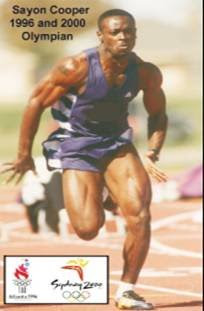
In 1952 Africa’s oldest republic was for the first time participating in the Olympic Games. A considerable number of Liberian Olympians already preceded Addy, Davies and Williams – among them Liberia’s fastest man, Sayon Cooper , a two-time Olympic participant representing Liberia in Atlanta and Sydney. Liberia can be proud of these men and women.


The 1996 Atlanta Olympics and the 2000 Sydney Olympics took place when the civil war was ravaging the country, destroying nearly all infrastructure, crippling the economy, causing many casualties. Liberia’s 14-year civil war cost many combatants their childhood and hundreds if not thousands of them their arms or legs as well.

When I was watching the Opening Ceremony and the Liberian representation I had to think of them. And I suddenly remembered a fascinating and emotional YouTube movie about Liberian amputee soccer players. Some of them were former child soldiers of opposing rebel groups. I will not dwell upon their history and conduct, it’s a sad story. Recruted, exploited and drugged by politicians-warlords they killed, raped, looted. But nowadays, after the demobilisation, they are representing Liberia too – as the Liberian Olympians do. They may not earn medals or other trophies – although… But they are representing the new Liberia. Look here for the Amputee All Stars, Liberia’s new hope.

Posted in Liberia, Ordinary Liberians | Comments Off on About Liberian Olympians and the Amputee All Stars

The definition of a Failed State

During the past week – while enjoying holidays in the quiet and attractive north-western part of Denmark, Jutland – I read the newspapers brought to our Liberia-get-together (see my July 6 posting). I found it both pleasant and frustrating to read them. It was comforting to hear from my friends that they shared my feelings.

We found it very impressive that a large number of newspapers are being published today and were surprised by the freedom of the press! More than ten are now sold in the Liberian streets; in an hap-hazard order: The New Democrat (from ‘old-timer’ journalist Tom Kamara), the Business Journal, The News, The Analyst, The Inquirer, The Informer, The Star, Monrovia Tidings, National Chronicle, Daily Observer, Plain Truth, Heritage.

The freedom of press, thus demonstrated, is absolutely an asset. For this reason we want to congratulate the Sirleaf-Administration. We have witnessed different times.

Furthermore, it was remarkable and also surprising to read these newspapers. It led us to two comments. One is that some of these newspapers were presenting ‘news’ and ‘opinions’ hardly based on facts and with no base. Nevertheless, these newspapers at times took a strong position, generally against the present government. Responsible journalism is not a nature-born gift. It needs proper attention of law makers and law enforcement officers.

Secondly, reading the newspapers one could not escape from the impression that ‘little had changed’- compared to thirty years ago when the daily and weekly newspapers were The Liberian Star, The Liberian Age, The Bentol Times, the Liberian Inaugural, Scope, The Sunday People, The Sunday Express, and The New Liberian.

I read with growing amazement and interest articles like ‘Gov’t Launches Campaign Against Hunger’, ‘More Transport Buses To Arrive Soon’, ‘Bong Range Iron Ore Deposits High Contested’, ‘Firestone: The Folly of a Nation Within’, ‘Three Men Arrested For Selling Human Parts’, ‘Trinity UMC Crowns Father of the Year 2008/2009’.

The first thought that came to my mind, however, was that little had changed over the past 30 years… I have the same articles in my archives from The Liberian Star, The Bentol Times, the Liberian Inaugural and other newspapers from the late 1970s.

Given the fact that a fourteen-year cruel and devasting war led to 250,000 deaths, a million refugees, another million people deplaced internally, the swelling of Monrovia to a more than one million people’s capital, the departure of most foreign investors and the virtual destruction of the modern economy, it is amazing to notice that Liberians have picked up life as it was before Doe’s dictatorship, 1980 – 1990, and the civil war (1989- 2003), fed by the unscrupulous warlords’ greed for power and wealth, leading to anarchy and destruction.

Liberians are an amazing people. Many people seem to agree that Liberia is a ‘failed state’ but I wonder what the definition is of a ‘failed state’ – to say the least. After all, we in Europe are closely following events in Belgium because of the split between Dutch speaking and French speaking Belgians, and the almost inevitable break-up of the country – sooner or later. But none of the Liberian warlords – Alhaji Kromah, Roosevelt Johnson, George Boley, Sekou Konneh, Charles Taylor, Prince Yormi Johnson, General ‘Peanut Butter’, General ‘Butt Naked’ – ever claimed a portion of the country. Separatism was not a driving force.

It was a crazy and cruel war. Greed, insanity and wickedness were its main ingredients. Liberia certainly is underdeveloped, but a failed state?

Sunday, July 6

A life altering experience

Today is a special day. The annual meeting of our Dutch organization Friends of Liberia is convening this year in Denmark. It is exceptional. Usually we meet in one of our members’ home towns in the Netherlands, but last year we accepted the invitation of our Danish friend to meet at her place in a small village in the north-western part of Denmark.

So here we are, twenty-seven people: twenty-four from Holland, two from Denmark and one from Finland. We were living in Liberia in the late 1970s, working at various places – most of us in Monrovia or nearby places. A few lived and worked ‘up country’. One was a medical doctor in Cape Mount, another worked in a Sanniquellie-based FAO project aiming at reducing post-harvest losses, yet another worked in Gbarnga for a humanitarian organization, two others worked for the Mano River Union and made frequent travels between Monrovia and Freetown over the then recently constructed Mano River bridge. Most of us worked in Monrovia: with the United Nations Development Programme UNDP, the West Africa Rice Development Organization WARDA, the School of Business and Public Adminstration of the University of Liberia, the Royal Netherlands Embassy. The great majority of us – about ten people – were agriculturalists, teaching and researching at Fendall, where since the mid-1970s the Agricultural School of the University of Liberia was located.

We then were all in our late twenties, early thirties, and our experience in Liberia was life altering. Some of us returned to the Netherlands after their stay in Liberia, others continued in a great variety of countries – Senegal, Sierra Leone, Nigeria, Burkina Faso, Mali, Tunesia, Egypt, Somalia, Ethiopia, Burundi, Mozambique, Malawi, Zambia, Iraq, Turkey, Thailand, Indonesia, the Fiji Islands, the United States, etc.. However, the Liberian experience was felt as the most impressive. It changed our lives and bound us together.

Liberia and the Liberian people captivated us. This tiny land, with it’s weird history – US free-born blacks, freed slaves and mulattoes who created Africa’s first republic in the mid-19th century and for more than a century ruled over twenty or more tribes although they numbered less then 50,000 (in the 1970s), and who seized over 90% of the nations’s national product – and with its fascinating culture, impressive nature, not to speak of its exhaustive climate – we all agreed: this ‘land of liberty’ had changed our lives.

Some of us are now retired – thought still active with voluntary work, often in the tropics. Others are educational and medical specialists, diplomats, public servants, or working in the private sector.

Inevitably, our thoughts and discussions were about the present state of affairs in Liberia. The devastating civil war, the actual reconstruction efforts, and the ‘Iron Ladies’. Most of us had seen this documentary film. But the comparison between what was and nowadays is, was saddening. Due to the civil war, the WARDA organization has been relocated from Monrovia to Ivory Coast – where another civil war intervened with its activities. The Mano River Union was paralysed because of the two civil wars: in Liberia and in Sierra Leone. Internationally-spondered projects (FAO, UNDP) were halted because of the war. The University of Liberia was ransacked, like many other buildings; the national health system was brought to a stand-still – to choose a polite formulation.

Now, all has to be rebuilt. Recently it was announced that China will give a US $ 22 million aid to restart Fendall, the agricultural branch of the Univerity of Liberia. Also, the Mano River Union is being revived (see my posting dated April 3, 2008). Virtually everything has to be rebuilt or re-started.

But our discussions were not negative or cynical. We all expressed hope and demonstrated great belief in the rebuilding of Liberia. One of us had brought a bundle of Liberian newspapers, recently acquired through his son-in-law, now working for an international organization in Monrovia. The large number of different newspapers, more than ten, was striking.

Our annual get-together is not unique in the Netherlands. There also exists the ‘Weaverbirds Club’. Generally, Weaverbird club members have worked with one of the numerous plantations in Liberia, or the iron ore mines. After all, it should not be forgotten that at one time, in the late 1960s, about 2,000 Dutchmen were working in Liberia, occupying various positions of responsibility in agricultural, mining, logging and trading organizations. The Dutch have a long history of relations with Liberia.

Posted in Civil War(s) Liberia, Liberia, Liberian History | Comments Off on The definition of a Failed State

Who knows Herman Cohen?

Who knows Herman Cohen? I came across his name when I read the report of his testimony before Liberia’s Truth and Reconciliation Committee (TRC) which recently convened in St. Paul, Minnesota, USA.

Herman Cohen was a former Assistant Secretary of State, during the Clinton Administration. He was Under Secretary for African Affairs from 1989 till 1993 and, earlier, Director of African Affairs from 1987 till 1989. He was an important American politician during a crucial period of Liberia’s history.

Herman ‘Hank’ Cohen was testifying on Thursday, June 12, at a public hearing of Liberia’s Truth and Reconciliation Committee on the role of the United States in the conflict in Liberia.

Let me briefly recall the TRC’s origin and mandate. The ‘truth’ committee effectively started its work in 2006. It is an independent body set up to investigate the root causes of the Liberian crisis, document human rights violations, review the history of Liberia, and put all human rights abuses that occurred during the period from 1979 to 2003 on record. The Truth Committee’s mandate is to also identify victims and perpetrators and make recommendations on amnesty, prosecution and reparation.

Yes, indeed, that is no easy mandate!

The astonishing news was that Mr. Cohen said that the US had an understanding with NPFL rebel group leader Charles Taylor to take power following the ‘voluntary’ departure of President Samuel Doe.

We are talking about the first half of 1990. Charles Taylor’s NPFL – composed of Americo-Liberians and Mano and Gio people, and supported by Ivory Coast, Burkina Faso and Libya (see my May 16 posting) – had invaded Liberia on Christmas Eve 1989. There was insignificant resistance of the Armed Forces of Liberia (AFL), loyal to President Doe, and Charles Taylor seemed to be sure of conquering and settling in the Presidential Executive Mansion in Monrovia.
Mr. Cohen said that he initiated discussions with Doe about leaving. The USA would provide the transportation. The understanding with Taylor was that he would take power as soon as Doe departed. After the plan was accepted by President Samuel Doe, Mr. Cohen called President Gnassingbé Eyadéma of Togo, who agreed to provide asylum for the desparate Liberian president. Following President Eyadéma’s consent, Cohen called Taylor on a satellite phone to open corridors for troops loyal to President Doe to allow them to escape through the Liberian-Sierra Leonean frontier. But the plan, he said, was messed up when former Independent National Patriotic Front of Liberia (INPFL) leader Prince Johnson seized control of Bushrod Island, a suburb of Monrovia, and blocked the corridor.

Meanwhile, Mr. Cohen said, when the U.S. was set to send an aircraft to carry out the evacuation, he received a directive from Washington to cease all engagements to end the Liberian conflict. To everybody’s surprise, Ambassador Cohen stated that no further explanations were provided by his superiors in Washington on the change in policy. At that point, he said responsibilities to intervene in the Liberian crisis were passed on to the Economic Community of West African States (ECOWAS).

That was in mid-1990. We know what subsequently happened. The USA – the Administration of Bush Sr. – gave priority to the First Gulf War (August 1990 – February 1991) and abandoned Liberia, evacuating its citizens without intervening. Then, on September 9, 1990 President Samuel Doe was captured, tortured and killed by Prince Johnson’ s men. The video tape which registered this gruesome act circulated all over West Africa and beyond.

After I had read the report I was flabbergasted for two reasons:

1) A little bit of history: Charles Taylor’s escape from a Massachusetts prison in September 1985 has never been satisfactorily explained. Persistent yet unconfirmed rumours suggested that he might have escaped with connivance of President Ronald Reagan (1981 – 1989) who – becoming increasingly embarrassed with the human rights violations of the Doe regime – wanted to get rid of his former protegé. This ‘theory’ has never been proven, but Mr. Cohen’s testimony indicates close contacts between the US administration and Charles Taylor – a fugitive (!) – although the latter’s whereabouts in North Africa (Libya) and West Africa (Burkina Faso and Ghana) in the late 1980’s as well as his support by Libyan President Muammar Gaddafi are largely unexplained and unknown.

2) The exact role played by Mr. Cohen remains a mystery. It is not commonly known, but Herman ‘Hank’ Cohen is (was) a much wanted lobbyist by African presidents who want(ed) to improve their public image. Most of these African rulers do not or did not have a very positive reputation (human rights violations, corruption). In the 1990s, he was reportedly hired by Burkinabe president Compaore, who had activily supported the December 1989 invasion of his friend Charles Taylor and who also supported Taylor in Sierra Leone. Mr. Cohen also was or had been on the payroll of Angola’s president Dos Santos, Zaïre (Congo), Ivory Coast, and…. Liberia – when ruled by Mr. Charles Taylor (1997 – 2003).
Source: Africa Confidential, May 12, 2000, vol. 41, no. 10, pp.2-6.

The foregoing raises the question: How reliable is mr. Cohen?

The above described lobbying activities are legal in the United States and are registered. One of the most successful lobbying firms in international politics is ‘Cohen and Woods International’. Directors are the former Assistant Secretary of State, Herman ‘Hank’ Cohen, and the former Deputy Assistant Secretary of Defense, James Woods.

Herman Cohen has been active in ‘special diplomacy’ in many countries: Burkina Faso, Côte d’Ivoire, Togo, Ethiopia, Somalia, Sudan, Rwanda, Zaïre / Democratic Republic of Congo, Mozambique…

Who is Herman Cohen?? Does anybody know???

Please let me know. Liberia needs to know.

Recommended readings:
Africa Confidential, May 12, 2000, vol. 41, no. 10, pp.2-6.
Herman J. Cohen: ‘Intervening in Africa: Superpower Peacemaking in a Troubled Continent’ (Macmillan, 2000).

About Herman Cohen:
Herman Cohen was U.S. Assistant Secretary of State for African Affairs from 1989-1993 and before that a Senior Director for Africa on the National Security Council Staff. He was U.S. Ambassador to Senegal and Gambia from 1977 to 1980. Ambassador Cohen is president of the consulting firm, Cohen and Woods International, a professorial lecturer at Johns Hopkins University, and author of the book Intervening in Africa: Superpower Peacemaking in a Troubled Continent (Macmillan 2000).

Posted in Civil War(s) Liberia, Coups in Africa, Liberia, Liberian History | Comments Off on Who knows Herman Cohen?

Population – Part I: The 2008 Population and Housing Census

I am on vacation right now and enjoy making daily trips in the surroundings. The diversity of the Netherlands is astonishing and refreshing. It is a small country, one hundred miles from east to west, and at most two hundred miles from north to south. Yet, we live here – peacefully – with over 16 million people.
Compare that to Liberia, also a small country, but with an area of 43,000 square miles (about equal to that of Ohio or Louisiana) and a population of around 3 million people. The exact number will be known as soon as the results of the recently held Population Census will be published.

Upon my return from the daily trips, after the evening-meal, I usually go to my study and dive into my archives in an attempt to reorganise them. Or I re-arrange the books in my bookcase. Some days ago I stumbled upon a book which caught and held my attention. It was Merran Fraenkel’s ‘Tribe and Class in Monrovia’. I had read it many years ago, and vividly remembered it’s contents. It was one of the most informative books on Liberia, that is to say, Monrovia, and it became a standard work. However, the book was not appreciated by the ruling class. The author carried out her fieldwork in 1958/1959. In those days there was a great divide between Monrovia’s ‘upper class’ and the tribal people. Also, there was a separation between the five coastal counties and the hinterland, composed of three provinces. The coastal areas and hinterland were separated by lack of roads and other means of communication – even by different laws! This only changed in the 1960s.

The ruling ‘Americo-Liberians’ then numbered about 25,000; the great majority of the population was composed of members of about twenty tribes. On linguistic, cultural and historical grounds four groups could be distinguished: the Kru and the Grebo; the Bassa; the Vai and Gola; and the Kpelle and Loma. Mandingoes, from the Mande-speaking regions north of Liberia, and Fanti, from the Gold Coast, nowadays Ghana, have settled in Liberia in more recent times.

This mosaic of peoples still exists, fifty years after publication of Merran Fraenkel’s book. Half a century has since elapsed; many changes took place. The investment boom of the 1960s brought some, much needed, modernisation but not the even more needed integration of the various components of the population. President Tubman’s Unification Policy – aiming at uniting the Liberian people – was continued by his successor Tolbert, but came to an end in the 1980s – the Doe era. After the devastating civil war was over, the economy was in ruins and the Liberian people more divided than ever.

Liberia’s first National Population and Housing Census since 1984 was launched in June 2007. It cost about US $ 6 million to conduct the census, which was held in 2008. During the operation, people were hostile to the census workers, removing the chalk X written on their huts and houses to mark and distinguish them from households not yet covered. The scars of the civil war were too fresh.

The census data are needed for planning purposes. To recover from the war. To rebuild the economy. As such, the census is an indispensable instrument for planners and politicians. The census results are eagerly awaited; they may become available before the end of this year.

But counting people is not the same as uniting people.

To be continued.
Part II will focus on The Truth and Reconciliation Commission of Liberia. Staggering confessions continue to emerge at the public hearings of the Truth and Reconciliation Commission (TRC). Can Liberians ever come to terms with the past?

Recommended reading:
Merran Fraenkel, ‘Tribe and Class in Monrovia’ (Oxford University Press, London; first published 1964; reprinted 1965 and 1970).

Posted in Liberia, Liberian Demography | Comments Off on Population – Part I: The 2008 Population and Housing Census

An end to impunity in Africa?

Charles Taylor is not the only former African head of state who is accused of crimes against humanity and war crimes and is being prosecuted. Today it was announced that Ethiopia’s Supreme Court has sentenced former Ethiopian ruler Mengistu – in absentia – to death. Already in 2006 Mengistu was found guilty of genocide after a 12-year trial and was sentenced to life in prison, but the State prosecutor lodged an appeal to demand the death sentence for the Red Emperor and his aides. The ‘Red Emperor’ – Mengistu’s nick-name – has lived in Zimbabwe since 1991. President Robert Mugabe has said he will not be extradited, but a presidential run-off is due next month in Zimbabwe and in case opposition leader Morgan Tsvangirai would win the elections, this decision could be subject to change.

In Senegal, another former African ruler is hunted. Since 1999 the victims of Chad’s exiled former president Hissène Habré are pressing the government of Senegal to prosecute Habré, accused of crimes against humanity, war crimes and torture committed during his 1982-1990 rule. Ex-dictator Habré was first indicted in Senegal in 2000 and the Senegalese authorities even arrested him in November 2005. The following year, in July 2006, the African Union mandated Senegal to prosecute Habré, to which Senegalese president Abdoulaye Wade agreed. Unfortunately, for several reason the Senegalese government is delaying opening proceedings against the former Chadian dictator who has lived in exile in Dakar, capital of Senegal, since 1990.

What do these three cases teach us?

I think that it is too early to conclude that the trials against Taylor and Mengistu and the efforts to bring Habré to trial announce a new dawn in Africa, more justice, less impunity. But they do give hope. However, recent political developments in Ethiopia where Meles Zenawi cracks down on the opposition, the refusal of Robert Mugabe in Zimbabwe to step down and the outburst of xenophobia in South Africa are opposite signs. How should we appreciate what happens? One step forwards, two steps backwards – or two steps forwards, one step backwards?

Related links:
Ethiopia’s Supreme Court sentences Mengistu to death:
http://news.bbc.co.uk/2/hi/africa/7420212.stm

Human Rights Watch: The case against Hissène Habré:
http://www.hrw.org/justice/habre/

Open letter to the international and African communities from the International Committee for the fair trial of Hissène Habré:
http://www.hrw.org/english/docs/2008/04/29/africa18666.htm

Senegal: Ex-dictator of Chad arrested:
http://www.hrw.org/english/docs/2005/11/15/chad12031.htm

Posted in African Politics, Charles Taylor, Impunity in Africa, Liberia | Comments Off on An end to impunity in Africa?