

A must-read is the Daily Observer article ‘Guus Kouwenhoven is Dead‘, with sub-title ‘Convicted war-crimes financier and “Timber Emperor”, dies at 84 without serving his 19-year sentence, leaving Liberia to reckon with the human and environmental cost of “blood timber”.
It’s a powerful article, published by the Liberian newspaper Daily Observer, and written by William Q. Harmon. It contains a thorough analysis of the Liberian conflict, the role of ‘blood timber’ and the role of unscrupulous businessmen like ‘timber-baron’ Kouwenhoven who – unfortunately – died without serving his well-deserved 19-year prison sentence.

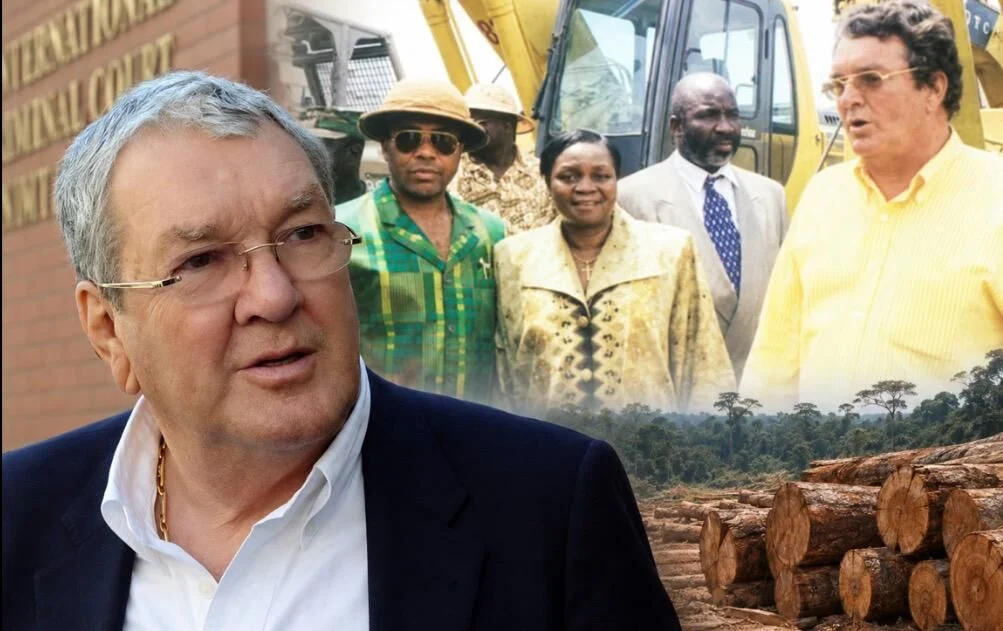
The author of the article, William Q. Harmon, rightly writes that: “Kouwenhoven’s story is not simply about one foreign businessman. (…..). It is about how the country’s extraordinary natural wealth—particularly its forests—was transformed into a financial and logistical resource for a war machine, how international businesses benefited from that system, and how ordinary Liberians paid the price.”
The Daily Observer article also elaborates on the excellent role of Global Witness, an international NGO examining environmental and human rights abuses. Global Witness reported extensively on the role of ‘conflict timber’ in Liberia’s back-to-back civil wars (1989-1997; 1999-2003), and the malicious collaboration between warlord-turned-president Charles Taylor and ‘timber baron’ Guus Kouwenhoven.
Taylor was found guilty of aiding and abetting war crimes in Sierra Leone and sentenced to 50 years in prison by the Special Court for Sierra Leone in 2012. At present Taylor serves his sentence in a maximum security prison in the UK. In 2017, a Dutch Court found Guus Kouwenhoven guilty of violating a UN-embargo, illegal arms trafficking and complicity in war crimes in Liberia and neighboring Guinea.
The Daily Observer article quotes Patrick Alley, co-founder of Global Witness who testified before the British Parliament, focusing on the relationship between timber and guns, and between Taylor and Kouwenhoven: “Funding conflict is one thing, which he (Kouwenhoven – FVDK) did through the timber trade. The ships which brought out the timber brought in the guns; that was a more serious issue.”
As William Harmon rightly concludes: “The timber business was not merely operating alongside the war. It was part of the war economy.”
That’s why the Dutch Appeal Court found Guus Kouwenhoven guilty and sentenced him to 19 years in jail. Kouwenhoven’s criminal activities had reportedly netted him US $50 million, enabling him to flee to South Africa and lead a luxurious life there. Expensive lawyers helped him stay beyond the reach of the law despite a Dutch extradition request.
Sadly, the case of Guus Kouwenhoven is ‘just’ another example of impunity.
Although the Final Report of Liberia’s Truth and Reconciliation Commission (published in 2009) recommended the establishment of an Economic and War Crimes Court, the report disappeared into a deep drawer. Not a single fighter has yet appeared in a Liberian court to answer for his or her actions.
Neither President Ellen Johnson Sirleaf (2006-2018), nor her successors George Weah (2018-2024) and Joseph Boakai (2024 – present) created a War Court. Why did they decide not to take on the warlords and other rebel leaders who committed heinous crimes including arson, looting, raping, killing and even cannibalizing innocent victims?
Unfortunately, in Liberia impunity reigns.
Why?
That’s an other story.
More on impunity in Liberia shortly.
PS To understand Liberia’s present problems one needs to delve into the history of this country, Africa’s oldest republic, created in 1847.
To be cont’d.
